Truth & Trump: A Platonic Perspective
- owenwhite
- Oct 26, 2024
- 6 min read

The Magnetic Pull of Truth in the Age of Trump
In a world saturated with misinformation, falsehoods, and conspiracy theories, it’s tempting to wonder if truth even matters anymore. Donald Trump, perhaps more than any other political figure in recent memory, seems to have built his career on bending the truth—or outright disregarding it. He lies with an ease and confidence that leaves many stunned. More troubling is the fact that millions of his supporters seem perfectly fine with this. For many, Trump’s lies aren’t a dealbreaker; in fact, some even embrace them.
What’s going on here? Why are so many decent people—who in their own lives value honesty—willing to overlook, or even endorse, such blatant deception? And more importantly, can this last? Is there something deeper in human nature that will eventually push people back toward truth?
Philosophers like Plato and Iris Murdoch offer some answers. They believed that truth, far from being just a social convention, is something we are naturally drawn toward. While we can be led astray by fear or manipulation, truth exerts a magnetic pull on us—a pull that, in the long run, cannot be denied. To understand this better, let’s explore how their ideas can shed light on the current moment and why the political culture of lies may ultimately be unsustainable.
Trump and the War on Truth
Donald Trump has often been described as a man unconstrained by truth. Fact-checkers tallied tens of thousands of lies during his presidency—an unprecedented level of dishonesty. And yet, Trump maintains a fiercely loyal base of supporters. Many seem to either dismiss his lies as unimportant or, worse, accept them as truth.
What’s particularly shocking is that many of Trump’s supporters are not bad people. Many, in fact, are very decent people—people who, in their personal lives, value truth and trustworthiness. They don’t lie to their families or friends the way Trump lies to the public. They don’t run their businesses or manage their personal relationships by distorting reality. So how do they reconcile their own commitment to truth with their support for a leader who seems to have no regard for it?
Fear and disillusionment are part of the answer. Trump’s supporters often feel betrayed by the political and economic system, and for many, Trump represents a form of retaliation against elites, experts, and institutions they no longer trust. They accept his lies because they see him as fighting for them, even if his means are dishonest. This is where Iris Murdoch’s insight becomes crucial: the vision of Trump’s supporters has become clouded by fear and frustration.
Murdoch argued that seeing truth requires moral clarity—clear-sightedness often obscured by ego, self-interest, or emotional distress. In this case, it’s not ego that distorts, but fear and anger. Trump’s supporters may genuinely believe he is their only hope in a corrupt system, and this belief distorts their ability to see his falsehoods for what they are. But this doesn’t mean they are immune to the pull of truth—it simply means their ability to discern truth has been temporarily clouded.
The Magnetic Pull of Truth
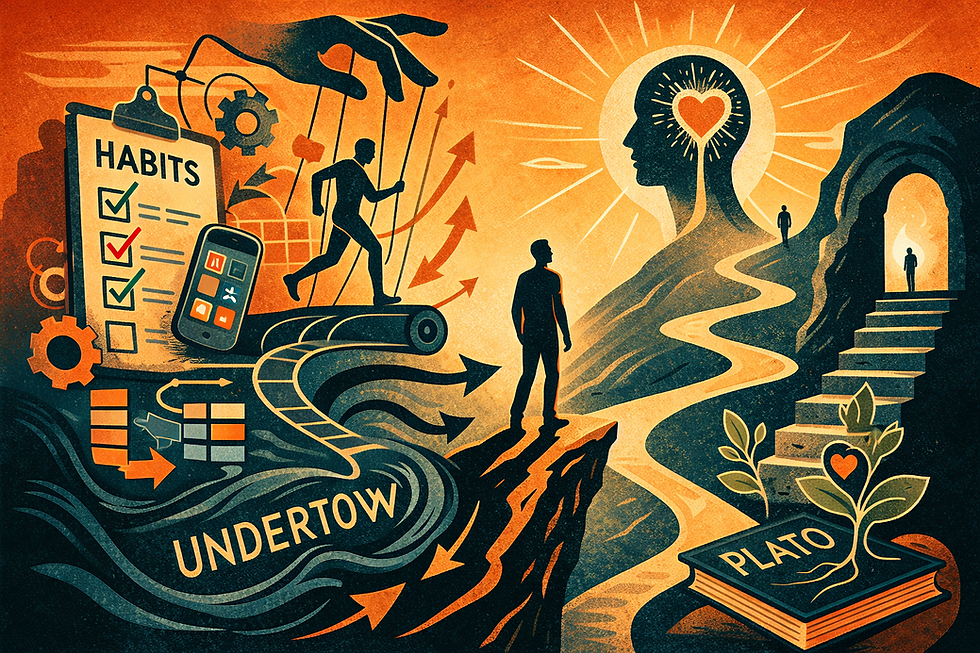
Plato and Murdoch both believed that truth exerts a kind of magnetic force on us. For Plato, this pull is toward the Good—the ultimate reality that gives meaning to all truth and morality. Even when people are trapped in falsehoods, Plato argued that they are driven by a desire for truth, whether they realize it or not. In his famous allegory of the cave, people live in darkness, mistaking shadows on the wall for reality. But once they glimpse the light—the true source of those shadows—they are drawn toward it, even if it’s painful or difficult at first.
Trump’s supporters, like those trapped in the cave, are currently stuck in a world of shadows, illusions, and misinformation. But Plato would argue that the human soul cannot remain in the dark forever. The Good—the ultimate source of truth—has a magnetic pull that eventually draws people out of their illusions and toward reality. This doesn’t happen overnight, and it can take time—sometimes tragically too much time, as in the case of Nazi Germany or Fascist Italy. But Plato’s insight is that truth has a power all its own, and eventually, people are forced to confront it.
Murdoch builds on this idea, adding a psychological and moral dimension. She believed that our ability to see truth is often obstructed by our desires, fears, and biases. But love, in her view, is the force that clears these obstructions. For Murdoch, love is about moral attention—attending carefully to others and to reality itself. To love is to see clearly, to remove the distortions of self-interest or fear.
Right now, many of Trump’s supporters are acting out of fear. Their love for the truth has been eclipsed by their emotional investment in Trump as a protector, a strongman who will save them from what they perceive as an overwhelming tide of cultural and political change. But Murdoch would argue that this clouded vision won’t last forever. Just as love has the power to clear our moral vision, the reality of Trump’s lies will eventually become undeniable for many who currently support him.
The Lessons of History
History is filled with examples of decent people supporting lies and deception, only to later reckon with the truth. Nazi Germany and Fascist Italy in the 1930s and 1940s offer sobering lessons. In both cases, millions of ordinary citizens supported leaders who lied to them and manipulated their fears. These regimes maintained power through propaganda, suppression of dissent, and a constant stream of falsehoods. For a while, many people went along with it—whether out of fear, nationalism, or a genuine belief in the leaders' promises.
But as the horrors of these regimes became impossible to ignore, the truth eventually broke through. For some, this reckoning came too late, after unimaginable suffering had already taken place. Yet even in these dark moments, the pull of truth was undeniable. In the aftermath, many former supporters had to face the painful reality that they had been complicit in a system of lies.
We see something similar in Russia today, where Vladimir Putin has maintained power through a mix of repression and lies. While many Russians support him, there are signs that the cracks in his reality distortion are starting to show. Reality, in the form of economic hardship, global isolation, and internal dissent, is beginning to push back against the false narratives that Putin has spun for so long.
The Personal Disconnect
What makes this political moment so strange is the disconnect between how people act in their personal lives versus how they behave politically. The same people who value honesty and trust in their personal relationships seem willing to embrace falsehoods and lies on a grand political scale. This disconnect is unsettling, but it also suggests that many Trump supporters are not beyond hope.
Most people don’t live like Trump. In their day-to-day lives, they don’t deceive their friends, lie to their families, or manipulate their co-workers. Most people understand, at a fundamental level, the importance of trust and truth in maintaining relationships. This is why, in the long run, the magnetic pull of truth will likely win out. As Murdoch would argue, decent people still have the capacity for moral attention, for seeing reality clearly once the clouds of fear and frustration lift.
Conclusion: The Enduring Power of Truth
It’s easy to be cynical in a world where lies seem to dominate our political discourse, but history and philosophy tell us that truth has an enduring power. Plato and Murdoch remind us that truth is not just a social convention—it’s something we are naturally drawn toward, even when we stray from it for a time. Donald Trump’s supporters, like the citizens of authoritarian regimes past, may currently be caught in a web of falsehoods. But the magnetic pull of truth remains strong.
Fear and frustration may cloud their vision for now, but reality has a way of breaking through. Whether through personal experiences, political consequences, or the sheer weight of Trump’s lies becoming undeniable, the pull of truth will eventually draw people back toward the light. It may take time, but truth, guided by love and moral attention, will have the final word.


Comments