After Bias, Before Truth: Why Plato still speaks to our broken world
- owenwhite
- Feb 8
- 7 min read

If you want to capture the strange mood of modern culture, notice this paradox. We are more aware than ever of bias—and yet less confident than ever that truth matters.
In workplaces, schools, and institutions, the language of bias is becoming routine. We are trained to recognise unconscious prejudice, to question the neutrality of our assumptions, to notice how power and identity shape perception. This represents a genuine moral and intellectual advance. A generation ago, these lenses were often invisible; today they are widely named.
And yet this heightened awareness has not produced greater mutual understanding. If anything, it has supercharged polarisation. The recognition that “everyone is biased” has quietly morphed into a more corrosive assumption: that no one ever really sees more clearly than anyone else. If all perspectives are shaped by power, then truth collapses into narrative. Politics becomes a struggle not over what is true, but over whose story wins.
This condition is often described as “post-modern,” as though it were a recent cultural mutation. But more than two thousand years ago, Plato described almost exactly this situation—its temptations, its dangers, and its psychological appeal. He did not do so from the safety of abstraction, but from inside a society already saturated with persuasion, manipulation, and power.
What makes Plato so disquietingly relevant is not only that he diagnosed a broken, power-infested public sphere. It is that he also articulated an alternative—rooted not in dogma or certainty, but in seeing: in attention, orientation, and the hard work of becoming less deceived.
⸻
A World Plato Would Recognise
Plato’s Athens was not a city naïve about politics. It had been defeated in war, wracked by factional violence, destabilised by demagogues, and humiliated by the execution of Socrates. Democratic institutions still existed, but trust had eroded. Public speech had become theatrical. Persuasion mattered more than judgment.
The intellectual climate was no gentler. Plato’s dialogues are crowded with figures who insist—often with impressive realism—that truth is inseparable from power. Thrasymachus declares that justice is simply the advantage of the stronger. Callicles mocks moral restraint as a trick invented by the weak. The sophists, consummate professionals, teach the arts of persuasion and success without troubling themselves about what is true.
These are not straw men. Plato gives them their due. They are clever, worldly, psychologically acute. Strip away the ancient idiom and you hear anticipations of Friedrich Nietzsche’s unmasking of morality as will to power, or Michel Foucault’s insistence that knowledge is entangled with regimes of power.
Nothing about the claim that truth is shaped by power would have surprised Plato. He had heard it argued forcefully, day after day, in the Athenian agora.
What interested him was not whether this claim was clever. It was what followed once it became the default picture of reality.
⸻
The Cave, Revisited
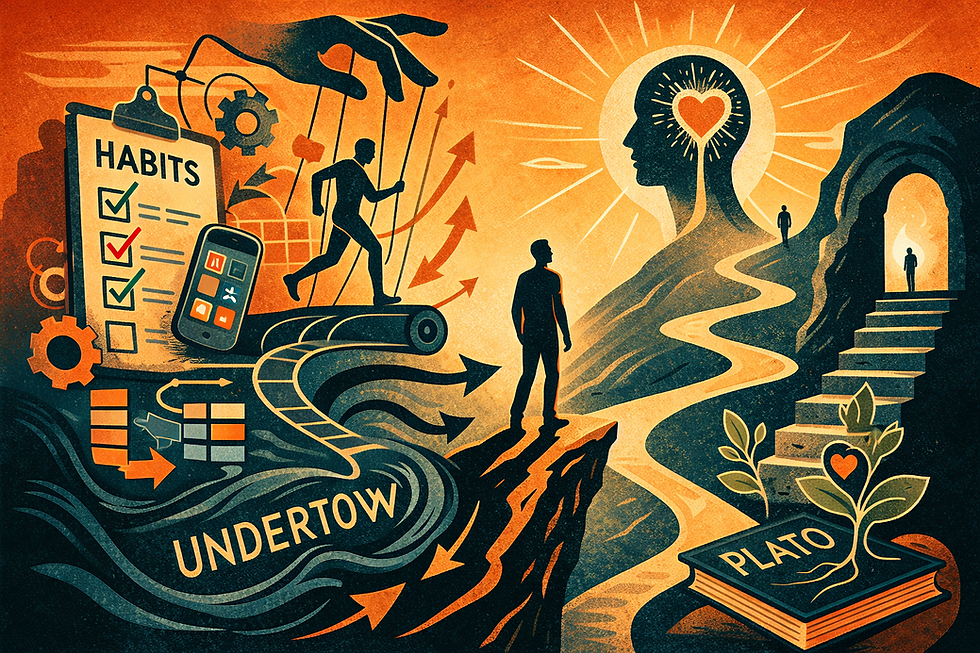
Plato’s most famous answer comes not as a theory, but as an image: the Allegory of the Cave.
A group of prisoners are chained underground, facing a wall. Behind them burns a fire; between the fire and the prisoners, others move objects that cast shadows. The prisoners take these shadows for reality. They argue about them, predict their movements, and reward those most skilled at interpreting the play of appearances.
What makes this image so unsettling today is how precisely it captures a culture that is intensely media-saturated and strategically manipulated. The prisoners are not ignorant. They are attentive, competitive, socially validated. Their problem is not lack of intelligence but lack of self-awareness. They do not know they are looking at shadows.
Plato adds a further twist that matters enormously for our time. Not everyone in the cave is equally deceived.
There are the chained prisoners: the many, absorbed in images, largely unaware of how their perceptions are being shaped. Modern bias-awareness has barely touched this group. They may be quick to point out the distortions in others, but remain largely blind to the lenses shaping their own reactions. They argue fiercely about shadows without suspecting that the spectacle itself is curated.
Then there are the puppeteers—the figures moving objects in front of the fire. These are Plato’s Thrasymachus and Callicles: men who understand perfectly well how the illusion works and exploit it. In our own time, their descendants are political operators and strategists—people like Roy Cohn, Steve Bannon, Stephen Miller, or Dominic Cummings. They are not chained. They know how narratives are constructed, how outrage is triggered, how public opinion is steered.
But—and this is crucial—they are still inside the cave.
Their sophistication does not amount to wisdom. They insist that the cave is all there is. There may be different chambers, different fires, different shadow-plays, but no exit. No sun. No reality beyond managed appearances. This is relativism with its sleeves rolled up: the belief that once you understand the illusion, the only rational response is to master it.
Plato’s refusal to accept this position is the fulcrum of his philosophy.
⸻
Is There Really a Way Out?
Plato would be the first to concede that the exit from the cave is hard to see. Even when a prisoner is released, the process is painful. The firelight dazzles. The new perspective feels unreal. The old certainties tug him back.
But Plato insists on something unfashionable and deeply disruptive: there is a difference between the confected images inside the cave and the reality outside it, whether or not people acknowledge that difference.
To modern ears, trained to hear every claim to truth as a power move, this can sound naïve or authoritarian. Plato anticipates the objection. He does not say that anyone has a God’s-eye view. He does not say that truth can be captured once and for all. He says something more modest and more demanding: that some ways of seeing are less distorted than others.
A simple example helps. Mathematical truths—“two plus two equals four”—do not depend on who holds power or how loudly they are asserted. They can be denied, even politically enforced, as 1984 famously imagines. But denial does not make them false. The human cost of such denial, however, is severe.
Plato takes this as a clue, not a template. Moral and political truth is not as clean as arithmetic. But the analogy matters. The fact that people disagree, or that truth is inconvenient, or that power can suppress it, does not mean there is no difference between seeing more clearly and seeing less.
This is where many modern relativists quietly stumble. In theory, they deny any hierarchy of understanding. In life, they constantly experience being wrong.
They regret past judgments. They recognise how anger or resentment distorted their view. They say, without irony, “I couldn’t see it then, but I can now.” This is not merely a change of opinion. It is a change in how the world appears.
Plato’s audacity is to take this ordinary experience seriously—and to extend it to culture and politics.
⸻
The Elephant, at the Right Moment
Here an ancient Indian story clarifies Plato’s intuition. Several blind men encounter an elephant. One feels the trunk and says it is a snake. Another grasps the leg and insists it is a tree. Each touches something real. Each description is partial.
The usual moral—“everyone has their own truth”—misses the point. The deeper lesson is that truth exceeds any single perspective, and that perspectives can be more or less adequate to what they encounter. The blind man who insists he has the whole truth is more mistaken than the one who acknowledges his limits.
Plato’s cave makes exactly this claim, but in political and psychological terms. Perspective does not abolish truth; it demands humility and orientation. The danger is not that we see differently, but that we mistake our partial view for the whole—and then weaponise it.
⸻
Seeing as a Human Discipline
At this point, Plato’s position can feel unsettling, even offensive. A friend hears you speak of “leaving the cave” and feels accused. Another bristles at the suggestion that some people might see the world better than others. Isn’t that elitist?
Plato’s answer is bracing: yes, in a sense—and no, in the way people fear.
There is, he insists, a hierarchy of consciousness. Some people are more self-aware, more moderate, less captured by fear or resentment. Some have done more of the work of examining their desires and testing their beliefs. This is not a claim about social rank or intelligence. It is a claim about formation.
Crucially, those who see more clearly rarely announce it as a power play. The Buddha did not issue press releases about his enlightenment. Nor did Socrates. Greater clarity usually brings less certainty, not more.
Plato’s alternative to relativism is not a doctrine but an ecology: logos, eros, and nous.
• Logos is disciplined questioning—the refusal to let our own views go unchallenged.
• Eros is what we care about—what draws our attention and motivates our inquiry.
• Nous is the fragile insight that becomes possible when desire and reason are properly aligned: the sense, felt “in the bones,” that something is genuinely the case.
Plato’s famous “leaping spark,” described in his Seventh Letter, names the moment when this alignment produces a qualitative shift in understanding. It cannot be forced. It cannot be transmitted by decree. But it is recognisable—and transformative.
This is not elitism in the sense of exclusion. It is a description of the human condition. Everyone is capable of greater clarity. No one is guaranteed it. The work is open to all, and completed by none.
⸻
Why Plato Still Matters
Plato did not save Athens. He did not dismantle the cave. He knew how strong the pull of illusion is. But he also refused to surrender to the claim that illusion is all there is.
In an age acutely aware of bias but deeply confused about truth, that refusal matters.
Plato helps us see why unmasking power without cultivating attention leads to cynicism. Why knowing that narratives are constructed does not absolve us from the task of seeing more clearly. Why democracy decays when persuasion replaces judgment. And why the most dangerous figures are not the naïve prisoners, but the skilled puppeteers who insist there is no exit.
His challenge is not comfortable. It disrupts relativism without retreating into dogma. It insists on hierarchy without authoritarianism. It asks us to accept that some people are wiser than others—not by birth or status, but by the work they have done on themselves.
In the end, Plato’s cave is not an insult to humanity. It is an act of faith. It assumes that we are drawn, however imperfectly, toward truth—that we can sense the difference between shadow and substance—and that even in a culture saturated with illusion, the pull of the sun has not entirely disappeared.
The question Plato leaves us with is not whether the cave exists. It is whether we are willing, however tentatively, to turn around.


Comments