The Modern Prometheans
- owenwhite
- Sep 28, 2024
- 6 min read
Updated: Oct 5, 2024

I. The Visionaries: Sam Altman and Demis Hassabis
Sam Altman, co-founder of OpenAI, and Demis Hassabis, founder of Google DeepMind, stand as two of the most prominent figures in the AI revolution, shaping a future where artificial intelligence can solve humanity’s greatest challenges. They believe that AI, particularly artificial general intelligence (AGI), will fundamentally change the world for the better, bringing unimaginable advances in healthcare, science, and technology. In their vision, AI isn’t just another tool—it’s the catalyst for a new era of human progress, one that will redefine what it means to be human.
Altman speaks passionately about AI’s potential to alleviate poverty, unlock scientific mysteries, and extend human life. Hassabis envisions AI as a way to accelerate scientific discovery, particularly in neuroscience and biology, where understanding complex systems can lead to breakthroughs in health and cognitive enhancement. For these visionaries, the transformational power of AI is undeniable, offering hope that problems we once thought insurmountable can be solved with enough intelligence and computational power.
Yet, beneath this vision lies a deeper question: why do they frame all human challenges as technical problems, solvable through computational means? What is driving this relentless push to control the world through algorithms, data, and machine learning? And is there something about the very nature of the human condition that cannot be addressed by technological solutions alone?
II. The Promethean Myth: Power and Consequences
The ancient Greek myth of Prometheus offers a useful lens through which to view these questions. Prometheus, in his audacious defiance of the gods, stole fire and gave it to humanity. Fire, as a metaphor for technology, allowed humans to transcend their natural limitations, giving them control over nature and the power to build civilization. But the myth also serves as a cautionary tale. Prometheus’s punishment—being eternally chained to a rock, with an eagle devouring his liver—illustrates that with power comes peril.
The Greeks understood that technical mastery could not solve all of life’s problems. In giving humanity fire, Prometheus also unleashed a force that could be used for destruction—warfare, industry, exploitation. The consequences of technological power, they warned, are not always foreseeable, and the desire to control nature is often a tragic misstep.
What the Greeks grasped, and what seems absent from Altman’s and Hassabis’s vision, is that not all problems can be solved with more control, more intelligence, or more technology. The quest for mastery over nature and human life, while noble in intent, can lead to unintended consequences, some of which we may not be able to reverse.
III. A Personal Observation: Has Tech Really Improved Life?
I find myself reflecting on the promise of technology—not just AI, but the many innovations that were supposed to improve our lives. I think back to a time before personal computers, the Internet, smartphones, and social media, all of which were once heralded as game changers for humanity. We were told these innovations would make us more connected, more efficient, and ultimately happier. But as I think about my own lived experience, I’m not sure that’s been the case.
Arranging to meet someone in the pre-smartphone era seems quaint now—picking a time and a place with no way to contact them if something changed. Yet, it largely worked. We didn’t know any different, and we were happy. Now, constant connection through smartphones means we’re never truly disconnected from work, social obligations, or the digital world. The convenience is undeniable, but I often wonder if it’s come at the cost of my well-being.
I was probably happier before these technologies proliferated. Life was simpler, more grounded in the present. And though tech has undoubtedly changed my life, I can’t say it has improved its quality. If anything, I feel more distracted, more pressured, and more disconnected from real, lived experience. Technology has introduced new forms of stress and anxiety, and the promise of a better, more efficient life often feels hollow.
This is where I see AI fitting in. The stakes are even higher with AI than they were with personal computers or smartphones, but I wonder if the outcome will be the same. AI will undoubtedly change everything, but will it make life better? Will it improve the quality of our lived experiences, or will it, like previous technologies, dis-improve them? The difference is, once AI is fully unleashed, there will be no going back. The genie will be out of the bottle, and the changes will be irreversible.
IV. The Limits of Technical Reason: The Greeks, Aristotle, and Practical Wisdom
Sam Altman and Demis Hassabis, in framing AI as the solution to so many of the world’s problems, seem to assume that all human challenges can be reduced to technical ones. In their view, more intelligence—whether human or artificial—is the key to unlocking the mysteries of life. But this perspective overlooks a crucial aspect of the human condition: not all problems are technical, and not all solutions are rooted in intelligence.
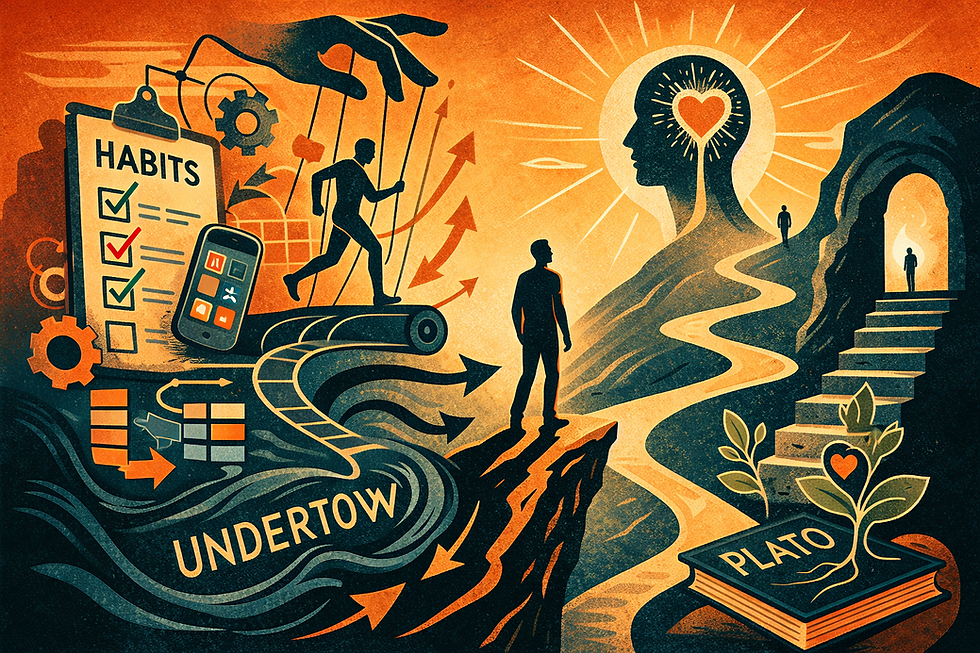
Aristotle offered an alternative view. He distinguished between techne—technical knowledge or skill—and phronesis—practical wisdom. While techne is about knowing how to make things or solve specific problems, phronesis is about knowing how to navigate the complexities of life. It is the wisdom to make good judgments, to understand what is worth pursuing and what is best left alone.
AI, as powerful as it may be, is rooted in techne. It is about the application of algorithms, data, and models to solve problems. But phronesis—the kind of wisdom that Aristotle prized—cannot be reduced to calculations. It is deeply human, shaped by experience, moral insight, and the ability to navigate uncertainty. This kind of wisdom is sorely lacking in the AI narrative, where everything is framed in terms of optimization and control.
The serenity prayer captures this insight perfectly: “God, grant me the serenity to accept the things I cannot change, courage to change the things I can, and wisdom to know the difference.” True wisdom is not about trying to control everything, but about recognizing the limits of control. AI, for all its power, is not capable of this kind of wisdom. It operates within a logic of control, seeking to master the world through computation. But the most profound human challenges—mortality, meaning, suffering—are not technical problems to be solved. They are existential realities to be accepted with wisdom and grace.
V. A Deeper Wisdom: Zen Buddhism, the Tao, and the Limits of Control
The Greeks weren’t the only ones who understood this. Zen Buddhism and Taoism, too, offer a view of the world that acknowledges the limits of control and the importance of wisdom. In Zen, the pursuit of control—whether over one’s mind, environment, or outcomes—is seen as a source of suffering. The goal is not mastery, but acceptance of life’s impermanence and unpredictability. Similarly, the Taoist concept of wu wei—“non-action” or “effortless action”—emphasizes the wisdom of aligning with the natural flow of life rather than forcing outcomes.
Both Zen and Taoist traditions, like the Greeks, recognize that life is a balance between action and acceptance, between control and surrender. They teach that true wisdom lies in understanding when to act and when to let go. This kind of wisdom is fundamentally different from the technical mastery that AI represents. While AI seeks to solve problems by exerting control, Zen and Taoism remind us that some aspects of life are beyond control, and trying to dominate them only leads to more suffering.
VI. Toward a New Understanding of AI’s Role
As we advance into the age of AI, it’s clear that the technology will change everything. But the question remains: will it make life better? Or will it, like so many other technologies, disrupt our lives without truly improving the quality of our lived experience?
The allure of AI is its promise to solve problems, to optimize our lives, and to bring order to chaos. But as the Greeks, Zen Buddhists, and Taoists all recognized, life’s deepest truths are not technical challenges to be solved. They are mysteries to be lived, understood, and navigated with wisdom.
Sam Altman, Demis Hassabis, and other AI pioneers are modern Prometheans, offering humanity the fire of artificial intelligence. But the lesson of Prometheus is not just about the dangers of overreaching—it is about the limits of control. AI will undoubtedly bring extraordinary advancements, but it will not replace the need for practical wisdom. As technology continues to evolve, we must not lose sight of the deeper truths about what it means to live a good life—truths that cannot be calculated or optimized by machines.
In the end, AI may change the world, but it cannot replace the human capacity for wisdom, acceptance, and understanding. And perhaps, as we stand on the brink of this new era, we should remember that the most profound changes in life are not always the ones we can control.


Comments