The Cult of Control & How it Blinds Us to a Better World

1. The Spell of the Machine
Few ideas have shaped the modern world more profoundly than the belief that everything is, at bottom, a machine.
When Newton described the laws of motion, Descartes separated mind from matter, and Bacon declared that nature should be “hounded in her wanderings,” the West was gripped by a dazzling new confidence: The world can be measured, modelled, and mastered.
That faith powered modern science and engineering — and the results were extraordinary. We built engines that could fly, machines that could compute, and medicines that could save millions
For three hundred years, each success confirmed the same cultural intuition: understanding means control. The scientific and industrial revolutions gave us a method for taming chaos — a way of turning the unpredictable into the predictable, the mysterious into the manageable.
By the late 20th century, this way of thinking had become so dominant that it was no longer seen as a way of knowing, but as the way. Our societies began to treat every problem — from education to economics, healthcare to happiness — as if it could be solved by the same logic that makes an aircraft fly or a vaccine work.
We became, in short, a civilization under the spell of the machine.
2. The Logic of Success
It’s not hard to see why. When you’re dealing with engines, circuits, or molecules, the world behaves beautifully. Cause and effect are stable. If a jet engine stalls, a skilled engineer can trace the failure, replace the faulty part, and restore order.
If a bridge collapses, it’s because a calculable law of physics was violated.
This is the world of what I will deliberately call complicated systems — the domain where science and engineering reign supreme. It’s the world that rewards expertise, precision, and prediction. It’s where the dream of control not only works but saves lives.
But from these triumphs came a dangerous generalisation: the assumption that everything in life behaves like an engineering system (also known as a machine), and that if only we gathered enough data, we could unlock the causal code behind every problem. And so we began to see society itself as a vast, optimisable machine.
3. The Extension of the Engineering Mind
By the early twentieth century, this way of thinking had migrated far beyond the laboratory. The early 20th century management theorist Frederick Winslow Taylor promised to make factories — and by extension, workers — as efficient as engines. His system of “scientific management” became the blueprint for how we organised not only production but all areas of life.
The same spirit animated public administration, economics, and education. Society came to be seen as a machine to be steered, regulated, and refined through data and rational design. Measurement became synonymous with progress; numbers became the only language of truth.
And yet, as the machine mindset expanded, it began to collide with parts of life that refused to behave mechanically.
You can’t tune a child like a carburettor.
You can’t “optimise” friendship or virtue.
You can’t debug a culture as if it were a faulty code.
Nevertheless, the success of the machine metaphor was so overwhelming that few dared to challenge it. Science worked. Engineering worked. Therefore, surely, the logic of science and engineering must apply everywhere. This assumption — that what works in one domain must work in all — became one of the great unexamined dogmas of modernity.
4. The Forgotten Third Mode
Two thousand years earlier, Aristotle had drawn a crucial distinction that could have saved us from this confusion. He identified three modes of human reasoning:
1. Episteme — theoretical knowledge, the search for universal laws and causes.
2. Techne — practical skill or craft, the art of making things.
3. Phronesis — practical wisdom, the art of acting rightly amid uncertainty.
Modern science and engineering are magnificent expressions of episteme and techne. But the realm of human life — the realm of judgment, choice, and consequence — belongs to phronesis - best translated as practical wisdom.
Phronesis is what allows a good teacher to sense when a student is struggling, or a wise leader to know when to hold back rather than intervene. It’s not about control, but about discernment and attunement — reading context, weighing values, and responding with care.
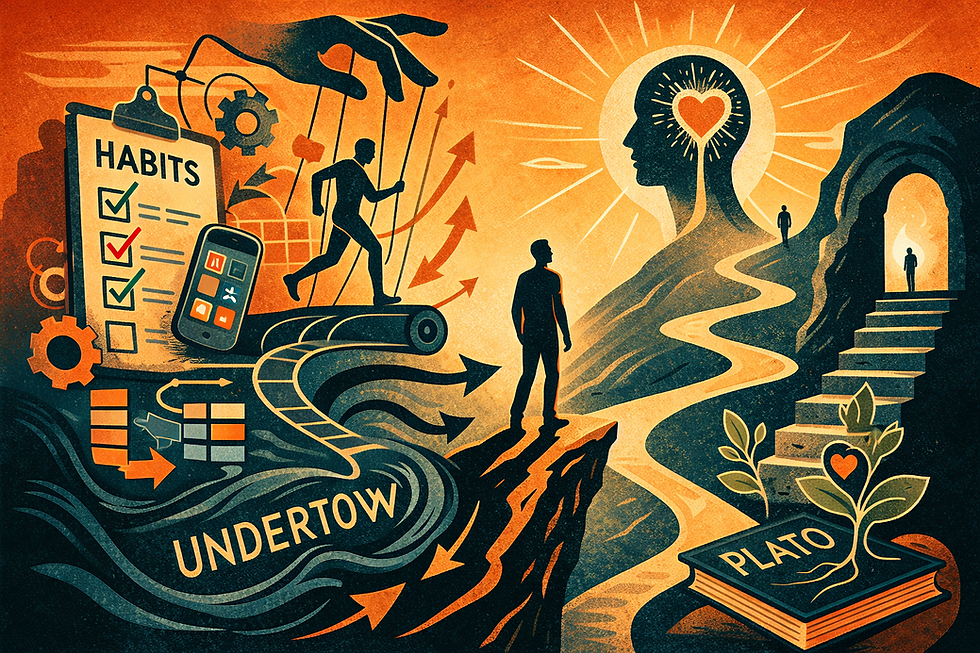
Modernity, dazzled by the success of episteme and techne, and concerned by the apparent "subjectivity" of personal judgement, quietly exiled phronesis. We replaced practical judgment with procedure, character with competence, wisdom with data. The machine could not feel, so, somehow we learned to distrust feeling.
5. The Cultural Consequences
The result is a culture that fails to understand the difference between the simple, complicated and the complex
In the simple world, cause and effect are obvious: flicking a light switch (the input) turns on a light (the output). In the complicated world, cause and effect exist but require expertise to understand: the workings of a Ferrari engine or the workings of a human heart.
But the complex world — the world of ecosystems, cultures, families, economies and human behaviour— is different. Here, there are cause and effect relationships, but causality can only be understood in hindsight. Feedback loops, adaptation, and context make outcomes unpredictable. You can influence the system, but not control it.
This distinction is not academic. It defines the boundary between where science and engineering are brilliant — and where they can be inappropriate and misleading. The tragedy of modern culture is that we have blurred this boundary. We have built entire institutions on the false hope that complex, living systems can be treated as complicated ones — that human life can be managed like machinery.
6. The Myth of the Solvable Society
You can see this confusion everywhere. In education, policymakers design curricula as if learning were a manufacturing process. They set targets, measure outputs, and standardise instruction — and then wonder why curiosity withers.
In healthcare, administrators treat hospitals as production lines, counting throughput rather than healing. They measure what can be measured and assume it must therefore be what matters.
In business, consultants promise “scientific transformation.” They roll out frameworks and KPIs that assume people are predictable components rather than conscious agents.
And when morale collapses, they commission another “change initiative” to fix the culture — not realising that culture is what happens when people adapt to the last change initiative.
Even in politics, the same logic holds. Politicans speak of “solving” poverty, “delivering” happiness, “engineering” growth — as if societies were engines that simply need better calibration.
This is not science. It is scientism — the belief that scientific methods, successful in one domain, can explain and control every domain. It is, as philosopher Mary Midgley once said, “a kind of imperialism of the intellect.”
7. The Crisis of Prediction
The result of this cultural overreach is a world that feels increasingly out of control.
Our models of control no longer fit the reality they’re meant to describe. Global finance, climate systems, and digital networks now behave in ways that defeat linear prediction. The more we try to manage them, the more volatile they become.
This is precisely what complexity scientists like Dave Snowden, Brian Arthur, and Stuart Kauffman have spent decades trying to explain: that complex systems cannot be reduced to neat lines of cause and effect. They are adaptive — they learn, respond, and evolve.
In such systems, interventions don’t just change outcomes; they change the rules of the game. Cause and effect are only visible after the event, not before it. That’s why climate models are constantly revised, why economic forecasts fail, and why organisational change initiatives so often collapse under their own weight.
And yet, despite the mounting evidence, the cultural reflex remains: when something fails, double down on control. Add more metrics, more data, more “AI-powered insights.” We respond to uncertainty not with humility but with dashboards.
8. The New Priesthood of Prediction
AI is the latest incarnation of this ancient dream of mastery. It promises that with enough data and computing power, the hidden patterns of the universe — even the messy patterns of human life — can be revealed.
In some areas, this is true. AI can detect tumours, predict traffic flows, or optimise logistics. These are complicated problems with stable patterns and abundant data.
But the boosters who believe AI will “solve” social, moral, and ecological crises are chasing a mirage. Climate change, inequality, and loneliness are not problems with stable rules. They are products of human systems in constant flux — systems that change in response to the very predictions made about them.
No algorithm, however powerful, can substitute for the moral reasoning, contextual judgment, and shared meaning that complex systems demand. AI, like engineering, is brilliant — but bounded. Unfortunately, too few who boost AI seem to recognise this fundamental reality. To treat it as the key to every lock is to misunderstand what kind of world we live in.
9. The Return of Complexity
What we are beginning to witness, then, is a slow cultural reckoning — a recognition that the methods of control which built the modern world no longer fit the world they have created.
Complexity is not new. It has always been the background condition of life. What’s new is that our tools of simplification have stopped working as well as they once did. The machine model, having reached its limits, is now exposing its blind spots.
In the past, those blind spots were absorbed by tradition, religion, and local culture — sources of meaning that acted as buffers against the cold logic of efficiency.
But as those buffers have eroded, we are left face-to-face with complexity itself:
the unmanageable, unpredictable, relational reality that Aristotle, Lao Tzu, and the Polynesian Wayfinders all knew intimately.
The challenge is not to eliminate complexity, but to learn to live with it again.
10. Living With Complexity
In the language of Dave Snowden’s Cynefin framework, complex systems cannot be managed through analysis; they must be navigated through experimentation. The right posture is not control but curiosity. We probe, sense, and respond.
We make small moves, watch what happens, and adapt. This is not weakness. It is how life works.
A gardener does not control the weather, but she does learn how to read it with humility. A teacher cannot predict how a class will respond, but she can adapt her tone and timing. A wise policymaker knows that every intervention changes behaviour in unforeseen ways, and so learns to listen before legislating.
This is the lost art of phronesis — practical wisdom reborn in the age of complexity.
It calls for humility, empathy, and patience — virtues our culture of engineering tends to treat as inefficiencies.
11. Towards a New Synthesis
The point, then, is not to abandon science or engineering, but to recontextualise them.
They are brilliant within their proper domains — where cause and effect are stable, where control is possible. But they must now take their place within a broader ecology of understanding.
Science explains.
Engineering makes.
Wisdom steers.
When we confuse those roles, we end up with clever systems and stupid societies — full of technical mastery but moral and civic bewilderment.
A mature civilization would know when to use each mode. It would celebrate science for its explanatory power without expecting it to deliver meaning. It would honour engineering for its craft without letting it colonise the moral and political sphere. And it would rediscover phronesis or practical wisdom as the art of navigating what can never be fully known or controlled.
12. Another World Is Possible
Is another world possible? Well, if we take on the critique offered above, then I think it is. Nor is it utopian. It's profoundly practical. It asks whether a civilization built on control can learn the art of participation. Whether a culture that worships prediction can rediscover the grace of uncertainty. Whether we can balance the brilliance of science with the wisdom of humility.
That balance will not come from rejecting modernity but from completing it — by adding the dimension it forgot: how to live wisely within complexity.
The future will belong not to those who can calculate best, but to those who can navigate best. To those who, like the ancient Wayfinders, can feel the shape of the waves even when the stars are hidden. To those who understand that life is not a system to be optimised but a conversation to be continued.
Science has given us extraordinary tools; now we must remember what those tools are for. They were meant to serve life, not to replace it. They were meant to illuminate the world, not to flatten it into data.
We don’t need to abandon the machine — only to remember that it was built by humans, for humans, within a living world. That means learning, once again, how to listen to that world rather than continuously trying to master it.
Because in the end, the greatest discovery of all may be this: that wisdom begins where control ends.
And if we can recover that truth — the one Aristotle, Lao Tzu, and the Wayfinders never forgot — then yes, another world is not only possible. It is already calling to us, just beyond the horizon.


Comments