The AI Mindset
- owenwhite
- Sep 29, 2024
- 5 min read
Updated: Oct 5, 2024

The Technological Mindset: How We’ve Reduced the World to Numbers and Control
For centuries, mankind has harnessed the power of scientific discovery to bend the natural world to its will. From the Industrial Revolution to the digital age, each leap in technology has brought us closer to mastering the elements, enabling feats that our ancestors could scarcely have imagined. We have extracted resources from the earth on an unprecedented scale, built cities that scrape the sky, and created networks that connect billions across the globe in an instant. Yet, as we stand on the precipice of ecological disaster—and the looming upheaval that artificial intelligence might bring—it’s worth asking: Have the remarkable achievements of the past few centuries come at too high a price? And are we hurtling toward a future shaped by the same mindset that led us to this brink?
The Essence of Technology: More Than Just Tools
When we think about technology, we usually picture our smartphones, laptops, or the sprawling networks of servers that power the internet. Mainstream thinking often holds that these tools are value-neutral—neither good nor bad in themselves. It’s commonly said that what matters is how humans use them: a knife can be used to prepare food or to cause harm; a smartphone can connect people across continents or distract us from those sitting next to us.
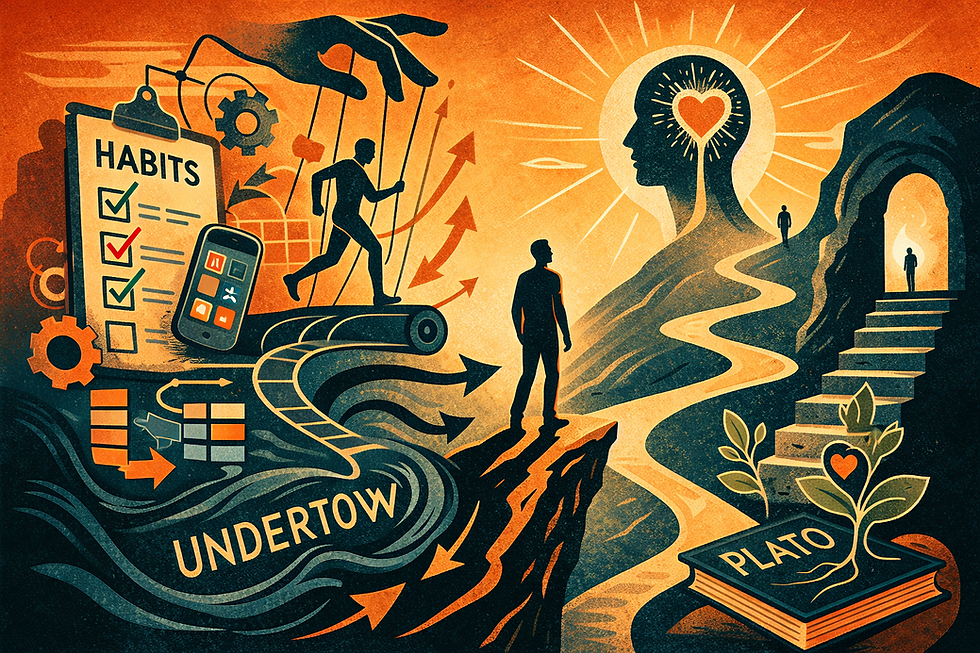
This "value-neutral" view of technology is comforting in its simplicity. It suggests that we remain in control, that we are the masters who decide how technology shapes our world. But the German philosopher Martin Heidegger offers a far more unsettling perspective. He argues that technology is not just a set of neutral tools; it is a way of seeing and engaging with the world that profoundly shapes our existence. This shift in perspective reveals that technology carries with it an inherent way of understanding the world, one that reduces everything—including humans—to resources to be managed, optimised, and controlled.
The Drive for Control: A Double-Edged Sword
The story of humanity’s relationship with technology is often told as a triumph of ingenuity and progress. The Industrial Revolution, for instance, marked a turning point where scientific knowledge was applied on a massive scale to transform agriculture, manufacturing, and transportation. This period of rapid technological advancement enabled us to produce more food, build infrastructure, and improve living standards across the globe. It also marked the beginning of an era where the earth’s resources were exploited at a scale never before seen in human history.
Coal, oil, and natural gas became the lifeblood of industrial society, powering factories, homes, and vehicles. The technological mindset that emerged during this period—what Heidegger would call the "technological enframing"—was one that saw the earth as an endless reservoir of resources, there for the taking. Forests were cleared to make way for farmland; rivers were dammed to generate electricity; minerals were extracted from deep within the earth to fuel the engines of progress.
But this relentless drive for control, while enabling incredible advancements, also sowed the seeds of ecological disaster. The same technologies that allowed us to dominate nature also led to deforestation, pollution, and the depletion of natural resources. Industrial waste poisoned rivers and air; chemical fertilisers and pesticides disrupted ecosystems; and the burning of fossil fuels began to alter the climate itself.
As we moved into the 20th and 21st centuries, the pace of technological development only accelerated. Nuclear power, genetic engineering, and digital technology offered new ways to harness and manipulate the natural world. But with these new powers came new risks—nuclear accidents, genetic mutations, and the erosion of privacy and autonomy in a world dominated by digital surveillance.
The Hubris of Control: Climate Change and Artificial Intelligence
The most profound consequence of our technological hubris is the looming threat of climate change. For decades, scientists have warned that the unchecked burning of fossil fuels is leading to a buildup of greenhouse gases in the atmosphere, trapping heat and causing global temperatures to rise. The technological mindset that enabled us to harness the power of coal and oil is the same mindset that now threatens to destabilise the very climate systems that support life on earth.
But climate change is not the only challenge that confronts us. The rapid development of artificial intelligence (AI) presents another, potentially even more disruptive force. Just as with the industrial technologies of the past, AI is often presented as a neutral tool—one that can be used for good or ill depending on human choices. Yet, like all technology, AI is not truly neutral. It embodies and amplifies the same technological mindset that has driven us to seek control over the natural world. It reduces complex human experiences to data points, prioritizes efficiency over empathy, and values calculation over genuine human connection.
As AI continues to develop, it has the potential to reshape the world in ways we can barely comprehend. From automating jobs to creating new forms of surveillance, AI could lead to massive social upheaval, widening inequality, and even the erosion of basic human rights. The same mindset that treats the earth as a resource to be exploited now risks treating human beings as mere inputs in an algorithm—valued not for their inherent dignity but for their utility in a system of control and efficiency.
The Dangers of Technological Enframing
But why does this matter? Isn’t technology just a tool that makes our lives better? Heidegger would argue that the danger lies precisely in how this mindset has permeated every aspect of our lives, often without us even realising it. The more we view the world through the lens of technological enframing, the more we lose our capacity to experience things as they truly are—outside the narrow confines of calculation and control.
Take nature, for example. When we view a mountain range as nothing more than a potential site for mining, we lose the ability to appreciate its majesty, its mystery, its place in the natural order. When a child’s education is reduced to a series of standardised tests, we miss out on the deeper, more profound aspects of learning that can’t be captured by numbers. And when we see our relationships in terms of what we can get out of them—whether it’s networking connections, social status, or emotional support—we undermine the very essence of what it means to connect with another human being.
Heidegger’s critique is not about rejecting technology or longing for a pre-industrial past. Instead, it’s a call to recognise the limits of our technological mindset and to rediscover ways of being that go beyond calculation. It’s about reclaiming the richness of the world—its beauty, its complexity, its inherent worth—that cannot be reduced to numbers or controlled through algorithms.
In practical terms, this might mean spending more time in nature, not as a hiker or a camper seeking to conquer the wilderness, but as a humble observer who appreciates the forest for its own sake. It might mean engaging in activities that resist quantification—like art, music, or meditation—that allow us to experience the world in a richer, more nuanced way. It could also mean rethinking how we approach work, education, and relationships, shifting our focus from efficiency and productivity to meaning and connection.
Ultimately, the price of our technological hubris is not just ecological disaster—it is the loss of our ability to truly experience and appreciate the world around us. As we grapple with the challenges of climate change, AI, and environmental degradation, we must also grapple with the deeper question of how we want to live in this world. Do we continue down the path of control and domination, or do we find a way to live in harmony with the earth, with each other, and with the technologies we create? The choice is ours, and it has never been more urgent.


Comments