Navigating Our Fractured Times

A woman I know—let's call her Sarah—works in child protection. Her job, she told me, is not really about following procedures, though there are thousands of pages of those. It's not about data either, though every decision she makes must be logged, scored, and benchmarked. Her real job, she says, is to sit in rooms with broken families and try to see what matters. She has to judge. But judgment, in today's system, is a dangerous word.
Sarah is a good example of what we have forgotten. That life—real life, not the one described in spreadsheets or debated on Twitter—is filled with decisions that are soaked in values. We make them every day. About children, fairness, safety, justice, dignity. And yet our culture, our institutions, and increasingly our technologies behave as if values are either private preferences or political minefields. The idea that there might be better or worse judgments—more or less truthful ways to see what matters—has become almost challenging.
This is not a new problem. But it has become newly urgent.
Today, political life is fractured between two poles: the resurgent right, with its moral certainties and truth-flavoured nostalgia, and a disoriented left, which often appears morally hesitant, anxious about imposing any view at all. One side bellows that truth must be defended; the other worries that all judgment is judgmentalism. In between sits a vacuum, where judgment should live.
But there is an alternative. One that is not new, but old—older than the Enlightenment, older even than Christianity. It begins with a man named Aristotle.
The Enlightenment's Guillotine
To understand what we lost, we need to understand what we were taught to forget. In the 18th century, the philosopher David Hume argued that one cannot derive an "ought" from an "is." You can describe facts, but you can't get values from them. This became known as Hume's Guillotine, and it set in motion a powerful cultural shift.
Science, it was agreed, would deal in facts: objective, observable, testable. Ethics? That would be about values: chosen, felt, constructed. Liberal society codified this distinction. And for a while, it worked. It protected science from theology. It protected politics from tyranny. But it also slowly and quietly removed truth from the domain of decision making.
The AI Crisis and the Moral Vacuum
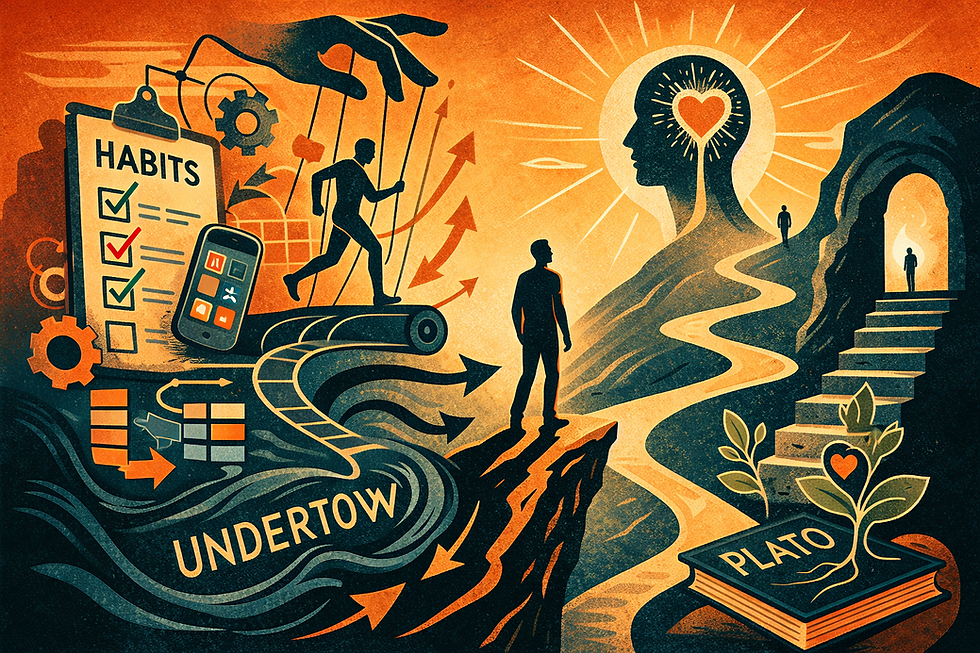
Fast forward to today. Artificial intelligence, our culture's most powerful tool, reflects this legacy perfectly. It is designed to optimise outcomes based on patterns in data. It can tell you what worked. It cannot tell you what matters.
But AI is now being used to make decisions that deeply depend on values: Who gets a loan? Who is flagged by police? Which students are ranked for support? The problem is AI doesn't know the good. It just knows the data. And we, having disarmed ourselves of the language of moral discernment, often don't know how to correct it.
Technocracy—government by data and process—compounds the problem. In a technocratic world, people are rewarded for managing risks and hitting targets, not for seeing what matters. We have inherited a culture that is suspicious of judgment and allergic to wisdom. That leaves us vulnerable to both algorithmic coldness and ideological heat.
Back to Aristotle: The Forgotten Virtue
Aristotle had a word for the kind of wisdom Sarah shows in those family meetings: *phronesis*. Practical wisdom. It isn't about knowing rules. It's about perceiving what matters in complex situations. It is a virtue built on experience, reflection, emotion, and moral attention.
For Aristotle, there was no fact/value split. Values were not chosen, they were discerned. The good life was not a subjective invention, but a shared project of human flourishing. This doesn't mean moral truths are easy. It means they are real—and really difficult.
Practical wisdom recognises that we live in particular times, with particular others, and that judgment must always be contextual. But it also holds that not all judgments are equal. Some are wiser, truer, more humane. To say this is not to be authoritarian. It is to be an adult.
Plato and the Problem of Perception
Aristotle's teacher, Plato, took the problem even deeper. In his famous allegory of the cave, prisoners stare at shadows on the wall, believing them to be real. Only a painful turning of the soul allows one to see the light. This, Plato believed, is the work of education: not just to inform, but to transform. Not just to teach facts, but to refine perception.
This is exactly what the philosopher Iris Murdoch argued in the 20th century. Murdoch believed that goodness was real, but hard to see. She called the ego "fat and relentless" and believed that moral vision was constantly clouded by pride, fear, and fantasy. Decision making, for Murdoch, was not a matter of choosing values, and following logic, but of learning to see. Attention, not choice, was key.
Practical Wisdom in an Age of Extremes
So where does this leave us? Between a moralising right that insists truth is simple and a moral-hesitant left that fears judgment altogether, we must recover a third path: the tradition of practical wisdom.
This is not about being in the middle. It is about being grounded.
* Grounded in the belief that truth exists, even if we see it only partially.
* Grounded in the belief that values can be reasoned about, even if they cannot be reduced to data.
* Grounded in the conviction that judgment is not bias, but a hard-won form of maturity.
This tradition doesn't offer certainty. It demands courage. It doesn't give us algorithms. It asks for attention. It doesn't assume we know the truth. It insists that we seek it—together, in context, in humility.
The alternative is what we have now: a vacuum filled by outrage, a culture that pretends to be neutral while smuggling in values through the back door, a society that acts as if all values are equal until it suddenly decides that some are non-negotiable.
We do not need to choose between dogma and drift. There is another way. Aristotle knew it. So did Plato. So did Murdoch.
And maybe, somewhere inside, so do we.


Comments