Failing to Fail: Tools and Techniques to Steer Innovation Success
- owenwhite
- Dec 18, 2024
- 4 min read

The Hard Realities of Innovation
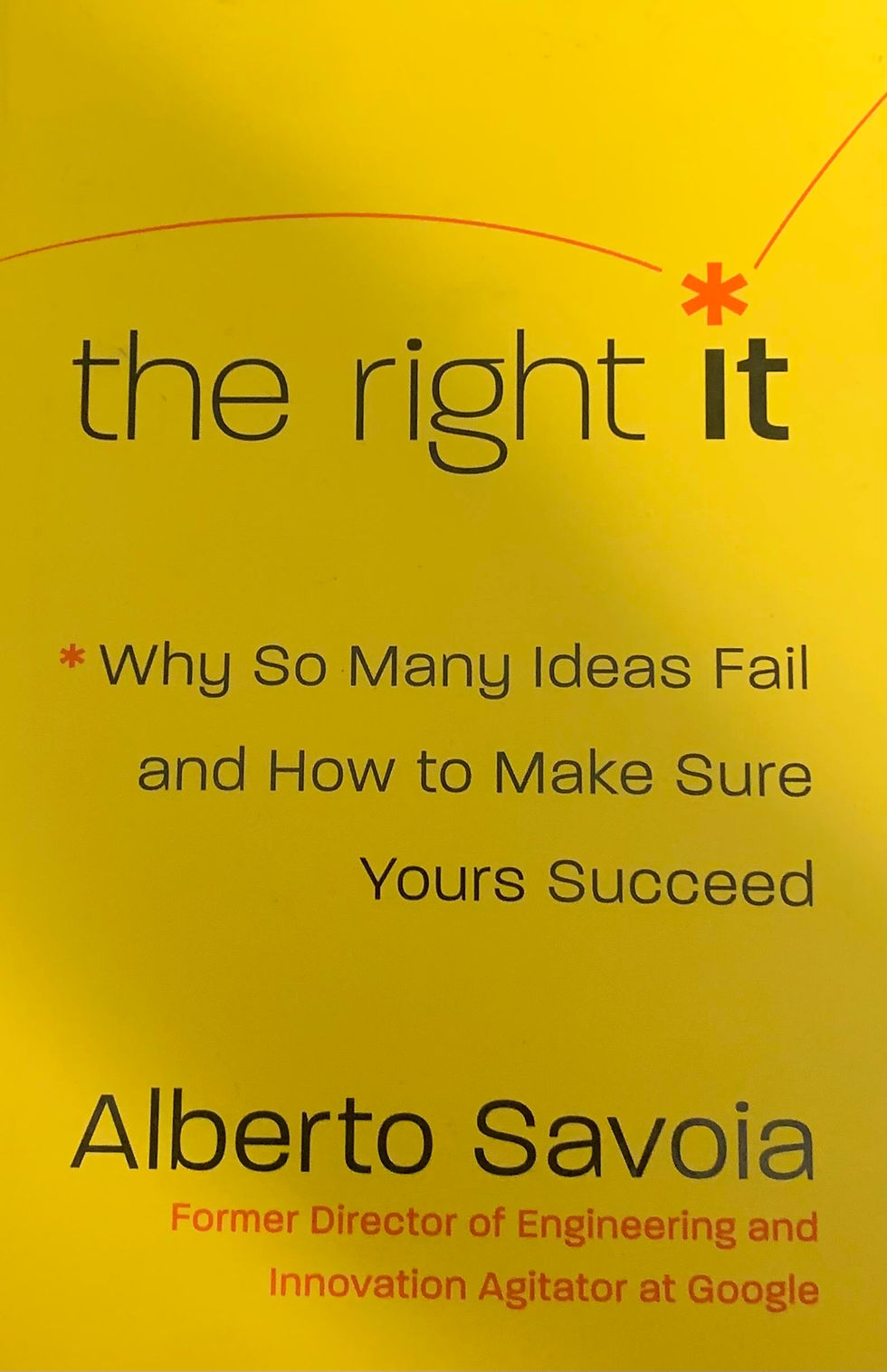
Innovation is seductive. It promises growth, disruption, and an edge in a competitive market. Yet the brutal reality is this: most new product innovations fail. Alberto Savoia, in his seminal book The Right It, reminds us of a daunting truth—the odds of success are stacked against us. Over 70% of new product innovations fail to meet their intended outcomes. This isn’t just a startup problem; it’s a challenge for even the most seasoned companies looking to diversify or enter new markets.
Part 1: Why Do Innovations Fail?
Savoia identifies the “Law of Market Failure,” which holds that most new products will fail, even if competently executed. The leading cause? Insufficient demand. Simply put, the market doesn’t want or need the product—or not enough people do to justify the investment. This failure often stems from two critical oversights: 1) Assuming a problem exists without validating it, and 2) Assuming a solution will resonate with the market without testing it.
Other factors include operational failures (the product doesn’t deliver as promised) and launch failures (the product doesn’t reach its audience). However, addressing demand issues early mitigates the lion’s share of risks. The curious thing is that many people miss this key point.
Part 2: The Framework to “Fail to Fail”
The key to innovation success lies in systematically avoiding common pitfalls. Think of it as “failing to fail.” By using structured, evidence-based methods, innovators can climb higher on the ladder of success, reducing the number of rungs left to climb.
The Problem Space vs. The Solution Space
The first step is understanding the distinction between the problem space (Does the problem exist? Is it significant?) and the solution space (Does your product solve the problem? Do customers prefer your solution over alternatives?).
Problem Validation: Prove that enough people care about a problem and are motivated to solve it.
Solution Validation: Ensure that enough people prefer your solution to the alternatives.
Failing to adequately test either leads to wasteful investments in “The Wrong It”—a solution that fails to resonate with the market.
Demand Profiling
Savoia emphasizes the importance of market validation through demand profiling. This process answers two pivotal questions:
Who wants this? (Who is the actual customer?)
How many of them are willing (and able) to pay? (What is the demand profile?)
An additional set of questions that help throw light on the above questions are: what is actual problem we believe the customer wants solving? How big and painful is it? How widespread is it? Does our solution actually solve this problem better than all competitor options (including the status quo?).
Tools like surveys, interviews, and early experiments (e.g., “Fake Door” tests) can provide initial answers and insights. But the key is to avoid hypothetical questions that encourage speculation and taint the answers. Don’t ask “Would you buy this?” That simply encourages people to speculate on how they will behave in a different circumstance in the future. The research shows that what people say they will do is a poor indicator of what they will actually do. Too often people do not do what they think they will do. A much better approach is to ask them about their past behaviour. Research shows this is a much better indicator of future behaviour.
Part 3: “Pretotyping”: A Practical Approach
Savoia introduces a powerful concept called pretotyping. Pretotyping differs from prototyping by focusing on testing the core market interest in a solution before significant development. It’s about answering the question: “If we build it, will they come?”
Types of Pretotypes
The Mechanical Turk Pretotype
Manually simulate a digital or automated service to test demand. Example: Use humans to fulfill tasks that the product would eventually automate.
The Fake Door Pretotype
Create a marketing campaign or a mock product page to gauge interest before building the product.
The Pinocchio Pretotype
Build a non-functional version of the product to showcase its form and idea without actual functionality.
The YouTube Pretotype
Use a simple video demonstration to explain the product concept and measure reactions.
The One-Night Stand Pretotype
Offer the product for a single-use or short-term trial to gauge interest and collect feedback.
By experimenting with pretotyping techniques, businesses can quickly and cheaply test assumptions, significantly reducing risk.
Part 4: Tools for Evidence-Based Validation
1. Market Engagement Hypotheses
Start with hypotheses about the market and validate them rigorously. For instance:
Hypothesis: “Teachers in urban schools need tools for faster grading.”
Test this hypothesis through surveys or interviews with teachers and administrators.
2. Data Over Opinions
Savoia champions the mantra “data beats opinions.” Traditional tools like focus groups often fail because they produce biased, speculative data. Instead:
Test real behaviour (e.g., monitor clicks, sign-ups, or purchases in controlled experiments).
Use metrics like conversion rates to validate interest.
3. Skin in the Game
Look for customer commitment. It’s not enough for customers to say they like a product idea—they must demonstrate commitment, whether through deposits, pre-orders, or contracts.
Part 5: Lessons for Established Companies
Established businesses face unique challenges in innovation:
The Innovator’s Dilemma: Existing revenue streams and customer bases can make it hard to prioritize disruptive innovation.
Failophobia: Employees often fear being associated with failed projects, leading to risk aversion.
Strategies for Success
Build a Culture of Experimentation: Encourage small, fast, and inexpensive experiments. Normalize failure as part of learning.
Test Locally, Think Globally: Start with small-scale tests (e.g., in one region or demographic) before scaling.
Lean on Pretotyping Tools: Use Savoia’s techniques to reduce time and cost during the early stages of product development.
Part 6: Conclusion: Beating the Beast of Failure
Innovation is a high-stakes game, and the odds of success may seem daunting. Yet, as Alberto Savoia reminds us, there are tools and techniques to stack the deck in your favour. By focusing on the right kind of market validation—grounded in real-world behaviour, not abstract opinions—businesses can make smarter bets.
The ultimate lesson? Start small, test relentlessly, and never let your assumptions outrun your evidence. If you want to “fail to fail,” commit to learning quickly, cheaply, and effectively. With the right approach, you won’t just innovate—you’ll create meaningful, lasting impact.



Comments